Lichens
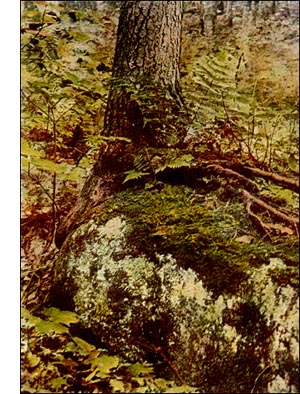 The foothold of the lichens is often so insecure that one must exclaim as he sees them, "How do you grow in such unfavourable places? On what do you subsist? No soil! No water! Dry as tinder! Crumbling at any rude touch! "If the plant could answer, no doubt it would say, "There must be pioneers to open up new territory for higher plants, so from the earliest times nature has employed us to do this work. We travel swift as the wind for we travel with the wind. We are fed by the rains and the dews, the hard rocks soften at our touch and give us food."
It is true that these little plants as they lie upon the rocks, secrete an acid which dissolves the hard minerals. It is true that they have the power to condense moisture from the air, however little it may be, for they must have water as an item of food and as a medium by which mineral-salts dissolved from the rocks may enter the interior of the plant and may pass from cell to cell to those parts where they are to be worked up into plant food.
The lichens are often the forerunners of rock-loving mosses as without the scanty soil prepared by their chemical action and, without the slight foothold which their debris afford, many mosses would be unable to get a start upon the forbidding rock.
Genus Cetraria
Genus Cladonia
Genus Parmelia
Genus Peltigera
Genus Physcia
Genus Stereocaulon
Genus Sticta
Genus Thelochistes
Genus Umbilicaria
Genus Usnea