Alsike Clover
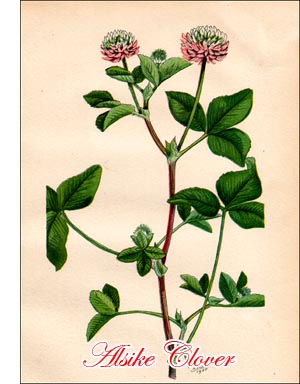 ALSIKE CLOVER (Trifolium hybridum L.)
Botanical description:
Alsike Clover is perennial With erect or generally ascending stems which do not root at the base as do those of White Clover. They usually reach a height of one or two feet and branch in their upper parts. The whole plant is hairlessand for this reason is brighter in colour than is Red Clover. The leaflets are shorter and comparatively broader. The flower heads have much longer stalks than those of Red Clover and in this Way are more like those of White Clover.
They differ from the latter, however, in coming from the upper parts of the stems, generally close to the top of the branches. In colour the flowers are between those of Red Clover and White. It must not be concluded from this fact, however, that Alsike is a hybrid, although its Latin name suggests the idea; the conclusion is entirely erroneous.
The colour of the flowers varies from white to rose, usually in the same head, because they are white when young and gradually turn rose-coloured. In all clover species the development of the flowers begins at the base of the head. As Alsike flowers are rose-coloured when fully developed and white when young, it is easy to understand how a blossoming head is generally rose-coloured in its lower part and white toward the top.
Biology of flower:
Like other clovers, Alsike is fertilized by insects. As the nectar is accessible to the ordinary honey bee, as well as to the bumble bee, the former is of more importance to Alsike than to Red Clover. When visited by a bee, the flower acts as does that of Red Clover. It will not produce seed if it has access only to its own pollen. Cross-fertilization between different plants must therefore take place.After blossoming the persistent flowers turn brown and bend more or less downwards. The individual flowers easily fall off, especially when the heads are dry; in Red Clover the ripened flowers are more firmly attached to the heads. The pod of Alsike is longer than that of Red Clover. It protrudes a little above the top of the flower and contains from two to four seeds.
Geographical distribution:
It is indigenous to the Old World, occurring from northern Italy to northern Sweden and from central France to southern and central Russia. It is also found in southwestern Asia and in some parts of northern Africa. It grows naturally along roads and streams, in moist meadows and on mountain sides.History:
Alsike Clover obtained its name from a small parish in central Sweden, called Alsike, where its cultivation began about a hundred years ago. It came into general use in Europe about the middle of the nineteenth century and is now commonly grown in practically all European countries except the most southern ones. In Canada it is cultivated to a noteworthy extent only in the eastern provinces. It frequently occurs, escaped from cultivation, in the Maritime Provinces, Quebec, Ontario and British Columbia.Cultural conditions:
Alsike prefers localities where moisture is abundant in the soil and in the air. The most suitable soil is a moist clay loam or clay. Like Red Clover, it requires time for its development. In central Ontario certain gravelly clay soils, rich in lime, are especially well adapted to it. It can be grown to advantage where the soil is too wet for ordinary Red Clover. On poorly drained land, where Red Clover would be a certain failure, Alsike will succeed, provided other conditions are suitable.Climate:
Alsike has not been successfully grown in Manitoba and Saskatchewan. This may be due either to the severe winter or to the dry growing season, or to both. European experience indicates that the dry summers may be the chief cause of the failure of Alsike in the Prairie Provinces. Prolonged drought prevents the young plants from making a good growth before cold weather and thus renders them susceptible to winter-killing. Even old, well-established plants are more seriously affected by drought than is Red Clover. This is doubtless due to the rather shallow root system of Alsike; it is not able to collect the moisture from the subsoil. In dry districts which are irrigated good returns are obtained.Habits of growth:
Under favourable conditions Alsike will flower late in the autumn of the season it is sown. Commonly, however, the plants enter the winter in the same stage of develop-ment as do those of Red Clover. The following spring the plants start comparatively late and do not bloom as early as ordinary Red Clover. Usually they are two weeks later and blossom about the same time as Mammoth Clover. If cut for hay, the aftermath develops quickly but is rarely sufficient to warrant a second cutting.Agricultural value:
When grown for hay Alsike is generally mixed with Red Clover and grasses such as Timothy and Red Top; on account of its spreading growth, it is liable to lodge if grown alone. When in mixtures, the stronger-growing grasses and clovers support the Alsike and the hay produced is of a finer quality. The common mixture in Ontario is two pounds of Alsike, eight of Red Clover and four of Timothy to the acre. As a rule ordinary Red Clover is used although it is earlier than the other two. If the mixture is cut for hay when Red Clover is at the proper stage, Alsike and Timothy are not ready, and if cut when the latter are at their best the feeding value of Red Clover has decreased. Alsike should be cut for hay when it is in full bloom or a little later; that is, when the earliest flowering heads begin to turn brown. Late cutting will not lessen the value of Alsike hay as much as that of Red Clover, as Alsike plants keep green and succulent for a comparatively long time. Usually only one crop of hay can be taken in a season. Harvesting can be done as for Red Clover. As a rule, however, the curing is less difficult, especially if the Alsike is grown with grasses.Pasture:
Although not eaten with the same eagerness as is Red Clover, Alsike is highly esteemed for pasture on account of its high feeding Value. Grazing can begin as soon as the plants have made a good start and it should never be delayed long enough to let them blossom. Given favourable weather, early grazing will make the pasture last longer than if the plants are allowed to develop more. On account of being perennial, it is preferable to Red Clover for permanent pastures. When grown alone, six to eight pounds of seed should be used to the acre.Alsike Clover picture
Alsike Clover seed