Plant GuideCactuses Ferns Flowers Fruits Grasses Alfalfa Plant Alsike Clover Awned Wheat Grass Barley Grass Barnyard Millet Beaked Rush Beard Grass Bearded Wheat Grass Bent Grass Bermuda Grass Black Grained Mountain Rice Black Grass Black Oat Grass Blue Joint Grass Bog Rush Bottle Brush Grass Bristly Foxtail Grass Broad Leaved Spike Grass Brome Grass Broom Sedge Grass Bulrush Bur Grass Bushy Beard Grass Canada Blue Grass Common Millet Common Vetch Cotton Grass Couch Grass Creeping Eragrostis Grass Creeping Fescue Crested Dogs Tail Grass Crimson Clover Cyperus Sedge Darnel Grass Dropseed Grass Early Bunch Grass Egyptian Grass False Red Top Grass Fescue Grass Field Paspalum Grass Fimbristylis Sedge Flat Pea Flattened Oat Grass Forked Beard Grass Fowl Meadow Grass Foxtail Millet Gama Grass Goose Grass Grass Leaved Rush Grass Pea Green Foxtail Grass Hairy Vetch Horse Bean Indian Corn Indian Grass Indian Rice Grass Italian Millet Grass Italian Rye Grass Kentucky Blue Grass Kidney Vetch Knot Root Grass Lace Grass Large Crab Grass Long Awned Wood Grass Low Spear Grass Mammoth Clover Manna Grass Marram Grass Marsh Foxtail Grass Marsh Oats Grass Marsh Spike Grass Meadow Foxtail Grass Meadow Oat Grass Meadow Sphenopholis Grass Muhlenbergia Grass Narrow Melic Grass Nodding Wild Rye Grass Nut Rush Nuttalls Reed Grass Orchard Grass Panic Grass Pearl Millet Perennial Rye Grass Pond Sedge Poverty Grass Purple Eragrostis Grass Purple Finger Grass Purple Oat Grass Purple Wheat Grass Purplish Aristida Grass Quaking Grass Rape Ray Grass Red Clover Reed Canary Grass Reed Grass Rice Cut Grass Rough Stalked Meadow Grass Sainfoin Salt Meadow Leptochloa Grass Sand Grass Sand Mat Rush Sea Beach Aristida Grass Sea Lyme Grass Seaside Oats Grass Sharp Fruited Rush Shear Grass Silky Oat Grass Silvery Hair Grass Slender Aristida Grass Slender Mountain Rice Grass Slender Paspalum Grass Slender Sphenopholis Grass Slender Spike Grass Slender Wild Rye Grass Slender Wood Reed Grass Small Crab Grass Soja Bean Spartinas Grass Spike Rush Spreading Spear Grass Squirrel Tail Grass Strong Scented Eragrostis Grass Sweet Vernal Grass Tall Grama Grass Tall Oat Grass Tall Red Top Grass Terrell Grass Timothy Grass Toad Rush Tufted Eragrostis Grass Tufted Hair Grass Vanilla Grass Variegated Alfalfa Velvet Grass Virginia Lyme Grass< Virginian Lyme Grass picture Wall Barley Grass Water Meadow Grass Wavy Hair Grass Western Rye Grass Western Wheat Grass White Clover White Grained Mountain Rice White Grass White Sweet Clover Wild Oat Grass Wire Grass Wood Meadow Grass Wood Reed Grass Wood Rush Wood Spear Grass Yard Rush Yellow Foxtail Grass Yellow Lucerne Yellow Oat Grass Yellow Trefoil Herbs Medicinal Plants Miscellaneous Plants Mosses and Lichens Mushrooms Nuts Spices Trees Vegetables Plant Dictionary Useful Websites |
Plant Guide > Grasses > Virginia Lyme Grass
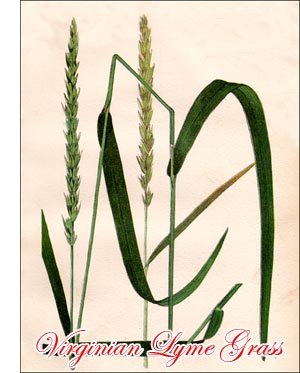
Virginia Lyme Grass VIRGINIA LYME GRASS (Elymus virginicus L.)Other English names: Bald Rye Grass, Wheat Grass, Terrell Grass. Botanical description:Virginia Lyme Grass is perennial with a very short rootstock and therefore grows in dense tufts. The stems, which are generally from two to four feet high, are numerous and densely crowded, smooth and rather slender, leafy to the top and often tinged with purple. The leaves are long and broad, the colour varying from bright green to glaucous. The lower leaves soon become brown and dry and at flowering time are usually all dead. The flowers are in a spikelike inflorescence.The spikelets are not solitary at each joint, as in the genus Agropyron, but are generally in pairs, making the inflorescence dense and crowded. Each spikelet has two sterile glumes at its base and there are consequently four sterile glumes at each joint. They are thick and clawlike, bent below, and make a characteristic mark by which Virginia Lyme can be easily distinguished from other Lyme Grasses. A spikelet contains two or three flowers, each enclosed within two narrow glumes. The outer flowering glume, the lemma, is awnless or with a short awn at its tip. When the awn is present the whole spike somewhat resembles that of rye; when it is absent the spike is more like that of wheat-hence the names Bald Rye Grass and Wheat Grass. Geographical distribution:Virginia Lyme Grass is indigenous to practically the whole North American continent. In Canada it extends from Nova Scotia to the Rocky Mountains.Habitat:It occurs on river banks, along borders of woods and thickets, etc. It is rather common in open woodlands but rare in open ground. This is why it is more frequent in the Maritime Provinces, Quebec and Ontario than in the Prairie Provinces.Cultural conditions:Virginia Lyme Grass stands drought and severe cold without injury and makes quite a vigorous growth on light, dry soil where many other grasses give a poor return.Agricultural value:Its agricultural value is rather doubtful. It is nutritive and succulent when young, but it quickly loses its feeding value and palatability as it gets woody and the basal leaves soon dry up and turn brown. If intended for pasture it should therefore be grazed early, and if grown for hay it should be cut quite green-long before the plants have started to flower. Its value as a pasture or hay grass is considerably lessened by its inability to produce a reasonable second growth.When sown alone, fifteen pounds of seed should be used to the acre. Virginia Lyme Grass picture |
| © 2004 - 2012 plantguide.org - Privacy Policy & Disclaimer |