Magnolias and Tulip Tree
 FAMILY MAGNOLIACEAE
Trees with soft, light wood, and fleshy roots. Leaves large, simple, alternate, entire. Flowers large, showy, perfect, solitary, terminal, all parts distinct. Fruit cone-like, compound, of many 1 to 2 celled follicles or keys imbricated upon a central spike.
The magnolias include twenty species; twelve are found in eastern and southern Asia, two in Mexico, six in eastern North America. Splendid as they are, tropical in foliage and magnificent in flower compared with everyday forest trees, the family is to-day but a shadow of its preglacial greatness. Forests of magnolias flourished in the midcontinental plains of Europe and America, extending northward even to within the Arctic circle. Fossil forests, uncovered by erosion and by volcanic forces that seam and split mountains apart, reveal the trunks and even the leaves and seed cones of these ancient trees. Amethyst Mountain, in Yellowstone Park, has such a story to tell, and European geologists can match it. Even in its decline, the magnolia family holds first rank among the ornamental trees of the North Temperate zone.
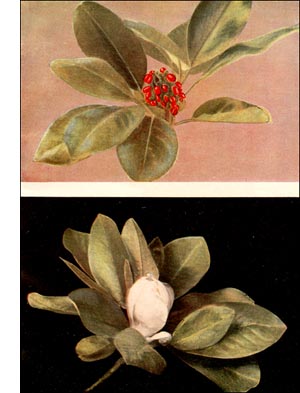
Magnolias are of peculiar interest because they have the largest flowers of any trees in cultivation. This is not saying that they are the showiest trees when in blossom, for an apple tree or a flowering dogwood may completely cover itself with blossoms. But the individual flowers of such trees are relatively small, while a magnolia blossom is often 6 inches, and sometimes a foot in diameter. Magnolias have several other points which make them a most attractive group; certain kinds bloom before the leaves in early spring; the flowers of most sorts are deliciously fragrant; the texture of the petals is notable, being thick, waxy and lustrous, and the colouring is exquisite. In many species the leaves are of extraordinary size, some exceeding a yard in length. In all, the foliage mass is luxuriant and tropical looking, Some have shining, leathery evergreen leaves-just the thing for Christmas decorations. Last, but no, least, there are the curious cone-like fruits which make the trees so attractive in midsummer and autumn. As they ripen they take on rosy tints, and later they open in a peculiarly interesting fashion, and hang out their scarlet seeds on slender, elastic threads.
Magnolias are not hard to grow. The essential thing is to choose the right kinds and to put them in the best locations. As they are, first and last, ornamental trees and shrubs, they are usually grown as single specimens on lawns, and the placing of them is important. Such a tree should have room enough to .attain its full development. A solid mass of evergreens is the most effective background for a fine symmetrical specimen, especially when it is in bloom. The soil should be rich and well drained, with good supply of moisture, for these trees are heavy feeders.
Magnolias can be obtained from nurserymen as lusty young trees ready for transplanting. They cost from 75 cents to $1.50. There are both native and exotic kinds for North and South. I would strongly urge everyone to refrain from taking young magnolias from the woods. They are scarce enough there, and transplanting such trees requires more than a general knowledge of such work. It is much better to leave them where they are.
Campbell Magnolia Tree
Cucumber Tree
Dwarf Magnolia Tree
Ear Leaved Magnolia or Mountain Magnolia Tree
Large Leaved Cucumber Tree
Magnolia or Great Laurel Magnolia Tree
Purple Magnolia Tree
Starry Magnolia Tree
Swamp Bay Magnolia Tree
Tulip Tree or Yellow Poplar Tree
Umbrella Tree
Watson Magnolia Tree
Yellow Cucumber Tree
Yulan Magnolia Tree