Oaks
 FAMILY FAGACEAE
Genera PASANIA and QUERCUS
Trees of great lumber and horticultural value. Leaves simple, alternate, entire or lobed. Flowers monoecious, inconspicuous; staminate, in pendulous catkins; pistillate, solitary or few in a cluster. Fruit, a dry nut in a scaly cup (an acorn).
The oaks form one of the largest and noblest of the tree families. There are 300 species recognised by botanists, and this probably does not include them all. They are distributed widely over the continents of the Northern Hemisphere, and follow the mountains through Central America and across the equator along the Andes. All but a very few species are large trees, important features of the landscape and the commerce of the countries in which they grow. Among broad-leaved trees they hold a pre-eminent place, and have held it from ancient times, in house and naval architecture and in bridge building. In durability, strength and toughness oak has few superiors.
Fifty species of oak are native to America; half of them distributed in the Eastern and mid-Continental regions, half on the Western slopes. The backbone of the continent, the main chains of the Rocky Mountains, have no indigenous oaks. No Pacific coast species is distributed also in the Eastern States, and vice versa. No European, Asiatic or American species is found outside its own continent, except as it is introduced by man.
The acorn distinguishes oaks from all other trees. It is the characteristic fruit of the family, and is found nowhere outside of it. All oaks bear acorns when they are old enough. Few begin bearing under twenty years of age.
The leaf of an oak is also characteristic. People usually learn to know an oak leaf from those of other trees without realising exactly how or why. There is great variety in the lobing of the !eaves, but they are all simple, alternate and almost always oval in outline, leathery, and cut by deep bays, called sinuses.
The flowers of oaks are separate, but near together on the new shoots. The staminate are in fringe-like catkins; the pistillate few-Fowered clusters in the axils of leaves; except in the genus Pasania. The acorns are either one or two years in ripening. It happens that annual-fruited species have rounded lobes and sinuses in their leaves. Quercus alba is the type of this class, and as these trees generally have pale bark, they are known as the white oak group. Biennial-fruited species have dark-coloured bark and the lobes of their leaves end in angles tipped with bristly points. They form the black oak group. Their type is Quercus velutina.
Basket Oak or Cow Oak Tree
Bear Oak or Scrub Oak Tree
Black Jack Oak or Barren Oak Tree
Black Oak or Yellow Oak Tree
Blue Oak or Mountain White Oak Tree
Bur Oak or Mossy Cup Oak Tree
California Live Oak Tree
California White Oak Tree
Chestnut Oak or Tan Bark Oak Tree
Chinquapin Oak Tree
Cork Oak Tree
Durand Oak Tree
English Oak Tree
Highland Oak Tree
Holm Oak Tree
Kellogg Oak or California Black Oak Tree
Live Oak Tree
Mountain Live Oak or Maul Oak or Gold Cup Oak Tree
Overcup Oak or Swamp Post Oak Tree
Pacific Post Oak or Oregon White Oak Tree
Pin Oak or Swamp Spanish Oak Tree
Post Oak or Iron Oak Tree
Red Oak Tree
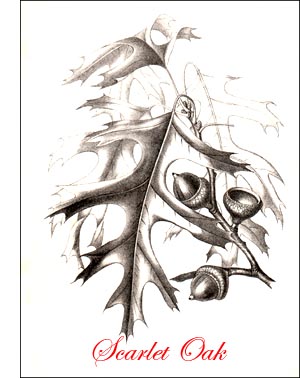
Scarlet Oak Tree
Shingle Oak or Laurel Oak Tree
Spanish Oak Tree
Swamp White Oak Tree
Tan Bark or Chestnut Oak Tree
Texan Red Oak Tree
Turkey Oak Tree
Water Oak Tree
White Oak Tree
Willow Oak Tree
Yellow Oak Tree