Pod Bearers
 FAMILY LEGUMINOSAE
Trees of high ornamental and timber value. Leaves compound (except in Cercis), alternate, deciduous. Flowers sweet, pea-like, or regular. Fruit, a pod.
The family Leguminosae, to which our pod-bearing trees belong, is one of vast size and economic importance, and of world-wide distribution. There are nearly 450 genera and over 7,000 species. Peas, beans, lentils, clover-all plants that bear simple, 2-valved pods after the flowers-are included. By this sign they are easily recognisable when in fruit.
Besides food stuffs, the pod-bearers yield rubber, balsams, oils, dyestuffs, good timber, and a long list of ornamental plants. The grass family, which includes the chief forage and grazing plants, the grains and sugar cane, is the only one that ranks higher than the legumes in service to the human family.
The pod-bearers are the only plants that have the power to abstract nitrogen from the air and store it in their stems and roots. The rotting of these parts restores to the soil that particular plant food which is most commonly lacking and the costliest to replace. The cheapest way to put nitrogen into the soil is to plough under green crops of clover, cowpeas, or other legumes. They improve the texture and therefore the moisture-holding capacity of the soil; commercial fertilisers do not. Legumes grow on poor soil and make it rich.
American pod-bearing trees belong to several different genera, with one or more species in each. With few exceptions they have handsome pinnate foliage, and showy flowers in drooping clusters. These characters, combined with an admirable form, give these trees prominence as ornamentals wherever they will grow. Their pods are often highly decorative in summer and winter. The thorns of certain species give the trees character and distinction. Several valuable lumber trees are included in the family. In North American forests seventeen genera of pod-bearers are native. These include over thirty species. Beside these, several exotic species are met with in cultivation.
Bristly Locust Tree
Cats Claw Tree
Chalky Leucaena or Mimosa Tree
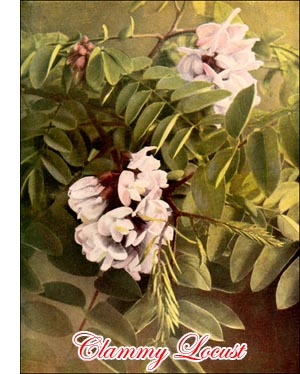
Clammy Locust Tree
Frijolito or Coral Bean Tree
Green Barked Acacia Tree
Honey Locust or Three Thorned Acacia Tree
Horse Bean or Retama Tree
Huisache or Cassie Tree
Jamaica Dogwood Tree
Kentucky Coffee Tree
Leucaena Tree
Mesquite or Honey Pod Tree
New Mexican Locust Tree
Red Bud or Judas Tree
Screw Bean or Screw Pod Mesquite Tree
Small Leaf Horse Bean Tree
Sonora Ironwood Tree
Sophora or Pink Locust Tree
Texan Ebony Tree
Texan Honey Locust Tree
Texas Redbud Tree
Water Locust Tree
Yellow Locust or Black Locust Tree
Yellow Wood or Virgilia Tree