Hornbeams
 FAMILY BETULACEAE
Genus OSTRYA Scop.
Small trees with very hard wood and scaly bark. Leaves simple, alternate, ovate, deciduous. Flowers small, monoecious, both in catkins. Fruits conical, hop-like, of many nuts, each one in an inflated sac.
Genus CARPINUS, Linn.
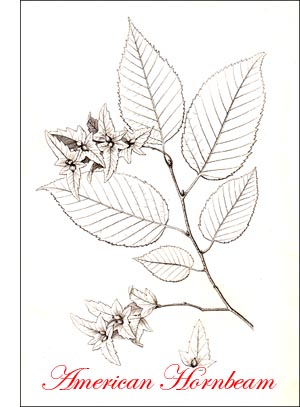
Small tree, with smooth, grey bark, showing swellings like veins. Leaves simple, alternate, oblong-lanceolate. Flowers, both sorts in aments, monoecious. Fruit, paired nutlets, each with a 3-lobed wing.
The hornbeams, or ironwoods, are little trees hiding in the shadows of the forest. They are of slow growth; their wood is very hard. They bear their flowers in catkins, the two sorts upon the same tree: the staminate axillary, the pistillate terminal. I he seeds are formed for wind distribution. Birches, alders, and that shrubby genus Corylus, the hazels, are associated by family characters. America has five of the six genera that compose the family.
As a rule the hardest woods come from tropical forests. Witness the lignum vitae, hardest of woods, which grow, in Florida, the West Indies, and northern South America; the mahogany of Central America; the rosewood from Brazil; and the ebony from Ceylon, tropical Africa and Cuba. Northern forests, too, furnish some species with exceptionally hard wood. The hornbeams are the best proof of this statement; the strength, hardness and flexibility of their wood rival steel. In durability they excel the best oak.
The name, ironwood, is locally given to any tree whose wood is hard.
American Hornbeam or Blue Beech Hornbeam Tree
European Hornbeam Tree
Hop Hornbeam or Ironwood Hornbeam Tree
Western Ironwood Hornbeam Tree