American Holly Tree
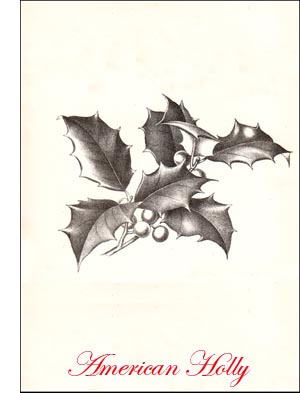 American Holly (Ilex opaca, Ait.)-A slow-growing, pyramidal tree, 20 to 45 feet high, with short, horizontal branches. Bark grey, warty; twigs brown. Wood white, close grained, tough, not strong. Buds short, pointed, brown. Leaves 2 to 4 inches long, oval, leathery, shiny, with wavy margin, veins ending in sharp, stiff spines; persistent three years.
 Flowers small, white, axillary in clusters, dioecious. Fruits bright red (rarely yellow), dry berries, containing 4 bony nutlets, remaining all winter. Preferred habitat, moist woodlands.
Distribution, southern Maine to Florida and throughout Gulf States; north into Indiana and Missouri. Maximum size in Texas. Uses: Valuable ornamental and hedge trees. Wood used as engravers' blocks, for tool handles, whip stocks, walking sticks and for inlay work. Branches for Christmas greens.
It is rare to find a wood which so closely imitates ivory in colour and texture as holly wood does. This makes it the delight of the carver and decorator. Scroll work and turnery employ it. Trunks of it form the rollers by which calicoes are printed. But the Southern woods and barren fallow fields where the holly grows are invaded every fall by collectors who cut the trees down, strip them of their twigs, and leave the trunks to rot upon the ground.
These twigs go to Northern cities, and retail dealers display in quantities, as wreaths and loose clusters, the evergreen leaves, bright with scarlet berries. In the remotest village one may now buy a sprig for his buttonhole to usher in the Christmas holiday. The supply is still ample, but no means of renewing it is being practised, and Nature will not be able to keep up much longer with the increasing demand, and the wasteful methods of gathering the annual harvest.
It will not be long before the engraver will have to buy holly wood, as he does the Eastern boxwood, by the pound. The European holly and the American are not essentially different in the quality and appearance of their wood.
American Holly Tree picture