Chinquapin Chestnut Tree
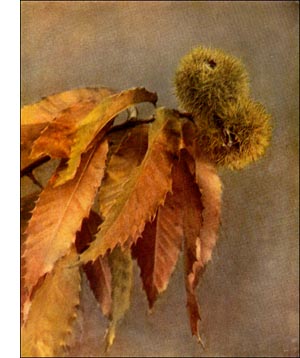 The Chinquapin (C. pumila, Mill.) is the chestnut in miniature-rarely a tree of medium height and spreading habit-usually a shrub that seizes the land by its suckering roots, and forms thickets on hillsides and bare ridges or on the margins of swamps. It is found from Pennsylvania to Florida, and west to Arkansas and Texas. It grows to be a tree west of the Mississippi River, reaching its greatest size and abundance in Arkansas and Texas. The leaves, flowers and nuts proclaim this tree's close kinship with the chestnut. A single ovoid nut with sweet kernel is contained in the globular spine husk. These are found in autumn in the markets of Southern cities.
The chinquapin grows lustily and fruits abundantly on a rocky bank in the Arnold Arboretum at Boston. This proves its hardiness far north of its natural range, and a sight of this thicket (or any other like it) must convince anyone that it is an ornamental shrub worthy of introduction into parks and private estates.
Where the chinquapin grows large it is used for railroad ties and fence posts. Its wood has the qualities of chestnut lumber, but is heavier.