The Golden - leaved Chestnut (Castanopsis chrysophylla, A. DC.), also called chinquapin, seems to be a connecting link between chestnuts and oaks. One American species represents the large genus which is widely distributed through Asia. Our tree grows from Oregon south along the mountain slopes that face toward the Pacific Ocean. In northern California it is one of the splendid trees of the coast valleys, often above 100 feet in height, with sturdy trunk supporting a broad, dense, rounded dome. The glory of the tree is its dark, lustrous foliage, lined with a yellow scurf. The leaves persist for two or three years, turning yellow before they fall. Thus the twigs are always decked with green and gold. The flowers are much like those of the chinquapin of the South; the sweet nut protrudes from a cup, or saucer, thickly set with long spines. One hardly knows whether to call it a chestnut bur or a spiny acorn cup. It is both-and neither. The coarse wood which resembles chestnut is sometimes used for ploughs and other implements. The bark is rich in tannin.
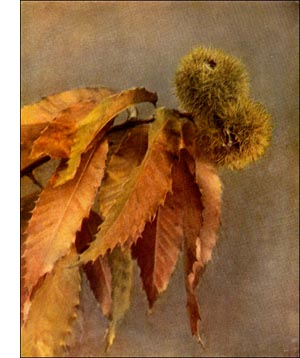 The Golden - leaved Chestnut (Castanopsis chrysophylla, A. DC.), also called chinquapin, seems to be a connecting link between chestnuts and oaks. One American species represents the large genus which is widely distributed through Asia. Our tree grows from Oregon south along the mountain slopes that face toward the Pacific Ocean. In northern California it is one of the splendid trees of the coast valleys, often above 100 feet in height, with sturdy trunk supporting a broad, dense, rounded dome. The glory of the tree is its dark, lustrous foliage, lined with a yellow scurf. The leaves persist for two or three years, turning yellow before they fall. Thus the twigs are always decked with green and gold. The flowers are much like those of the chinquapin of the South; the sweet nut protrudes from a cup, or saucer, thickly set with long spines. One hardly knows whether to call it a chestnut bur or a spiny acorn cup. It is both-and neither. The coarse wood which resembles chestnut is sometimes used for ploughs and other implements. The bark is rich in tannin.