Genus Andraea
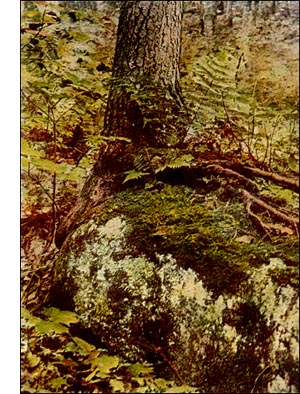 Genus ANDREAEA, Ehrh.
The species of the Genus Andrea are found in small, brown or black, -fragile tufts on granite or slate rocks in high altitudes. They are among the first mosses to grow on rock and are efficient agents in preparing soil for higher forms of plant life. The plants are small with forked branches which start from just below the flower-bearing apex. The leaves are thick, open or spreading, ovate to lance-shaped and usually have their surface covered with projecting points.
The terminal oval spore-cases are immersed among the leaves before maturity, but later are protruded by the elongation of the cellular sheath (vaginule) surrounding the base of the spore-case.
This is known as a false pedicel (pseudo-podium). There is no lid, as the case opens by splitting perpendicularly into four or rarely six equal segments which cohere at the apex.
There are, of course, no teeth when there is no lid. The small spores are at first coherent in fours, later, when the case splits into valves, they are disseminated by the wind, if the weather is dry; if it is damp, the valves draw together to protect the spores.
There are about one hundred species known at present, six or more of them occurring in North America. The specific characters are drawn mainly from the leaves.
By the early writers these mosses were classed with the leafy hepatics (Jungermania) on account of their manner of opening the spore-case by valves instead of by a lid. They agree in structure with the true mosses. Their proper place seems to lie between the peat-mosses and leafy-mosses. They agree with the peat-mosses because the spore-case is first enclosed in a saclike vail and then elongated on a false pedicel. They agree with the genus Grimmia in habitat, manner of growth and in structure of their leaves, differing chiefly in the opening of the spore-case.
The name was given by Fredrich Ehrhart, in honour of his friend J. G. R. Andreae, a Hanoverian naturalist.
Rock Andraea
Stone Loving Andraea