Genus Racomitrium
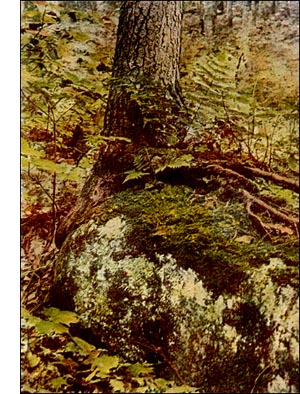 Genus RACOMITRIUM, Brid.
The species of the Genus Racomitrium are usually of large size, with stems branching in pairs, the branches simple and all reaching the same height, or unequal, in lateral clusters. They are widely and loosely tufted on rocks in mountainous regions. Many of the species resemble the Hypnum mosses on account of their long prostrate stems, their numerous short branches, and their apparently lateral spore-cases.
The name is from the Greek for; a shred, and; a veil, referring to the torn base of the veil.
The leaves are not tufted at the top of the stems but are close, nearly equal, long, lance-shaped, concave and channelled, with an apex blunt or ending in a fine point or hair; the margin is recurved; the cells are usually obscure, rounded or four-sided in the upper part, and long and narrow in the lower part.
The spore-cases are oblong cylindrical, narrowed at the orifice and usually erect on erect pedicels. The lids are small and more or less beaked and the peristome consists of a single with two cells row of sixteen long teeth cleft two or three times to below the middle, or divided into two thread-like, knotty, nearly equal segments, erect when dry, rarely spreading. The annulus is compound, rolling back when the lid falls.
Eighty-one species are known at present, twenty in North America. They are mostly distinguished from the species of the genus Grimmia by the peculiar narrow and wavy cellstructure of the leaf-base in conjunction with their habit of growth.
Woolly Torn Veil Moss