Amblystegium Varium Moss
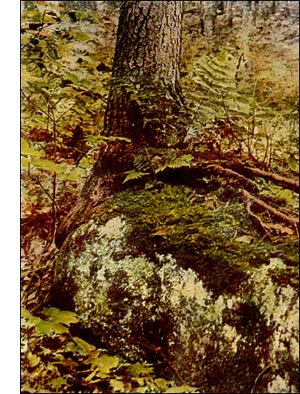 Amblystegium varium, (Hedw.)
Habit and habitat.-This species is found growing in extensive loose or crowded tufts, bright green, dull dark green or pale yellow-green, on ground, decayed wood, bases of trees and rocks in moist, wet or shady places.
Name.-The specific name, varium, refers to the variable character of the plant.
Plant (gametophyte).-The plants are of small or medium size, the stems obscurely angled, prostrate and branched, the branches slender, irregular, erect or ascending, never plume-like, straight or with tips incurved.
Leaves.-Leaf-cells spreading or appressed, flat or concave; variable in size and shape, lance-shaped to ovate-lance-shaped or broadly ovate; apex usually slender, straight or slightly curved; margin entire to toothed above; vein extending to the apex or well into the point; cells broad and applied end to end (parenchymatous) toward the base, and narrow, with the ends overlapping (prosenchymatous) toward the apex.
Habit of flowering.-Male and female flowers on separate plants.
Veil (calyptra).-Small and falling early, equal to or shorter than the spore-case, split half the length.
Spore-case.-Cylindrical, unsymmetrical, upright to horizontal, pale yellow-green when young, chestnut when mature; constricted under the mouth when dry; neck 1/4 to 1/2 the length of the spore-case.
Pedicel (seta).-One-half inch to 2 inches long, stout, reddish at the base, pale-yellow or dark throughout.
Lid (operculum).-Obliquely pointed from a high convex o. conical base.
Annulus.-With two to three rows of cells.
Teeth (peristome).-Cinnamon brown or yellow, paler above, lance-shaped; cilia 2 to 4.
Spores.-Mature in late spring.
Distribution.-Common and widely distributed.