Feathered Neckera Moss
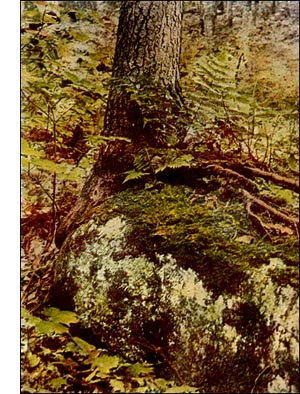 The Feathered Neckera, Neckera pennata, Hedw.
Habit and habitat. - Growing in widely spreading pale-green matted tufts (cespitose) on tree trunks. It is a conspicuous moss on trees of the Adirondack woods. The older parts of the plants are shabby, while the newer parts are pale yellow-green and grow horizontally around the tree.
Name.-The specific name pennata, from the Latin Penna, a feather. was suggested by the arrangement of the branches.
Plant. (gametophyte).-The primary stems are long, the secondary 2 to 4 inches long in opposite rows (distichous), close or distant, erect.
Leaves.-In the same plane with the branches, spreading, glossy, broadly lance-shaped, transversely wrinkled ; apex acute ; margin entire or slightly saw-toothed from the middle upward ; vein faint and short, single, or two-forked, or wanting ; base slightly unequal ; cells very small, rhomboidal-oblong. 4-sided at the basal angles.
Leaves at the base of the pedicel (perichaetial leaves).Long and sheathing, taperpointed, surpassing the sporecase.
Habit of flowering.-Male and female flowers on the plant (monoicous).
Veil (calyptra).-Small, white, covering the lid only.
Spore-case.-Immersed, oval-oblong, dirty-yellow, brown when old, thin-walled.
Pedicel. -None, the cellular sheath at the base of the spore-case hairy.
Lid (operculum.)-Conical, beaked.
Teeth (peristome).-Pale-yellow, the outer of linear awl-shaped teeth from a narrowly lanceshaped base, cohering at the apex, densely crossbarred, irregularly divided, the inner segments rudimentary.
Spores.-Mature in spring.
Distribution.-Common in North America; universal